Overview
Led product design and development for SWARM, a distributed computing platform that transforms e-waste into accessible computing resources for researchers. Conducted 30+ user interviews across Claremont Colleges (8500+ students) to identify pain points: 4525 devices wasted annually with only 15% disposed responsibly.
Designed 3-part solution (Collect, Collate, Compute) with Figma prototypes and proof-of-concept distributed system achieving 15% faster computation by adding one e-waste node. Presented to panel of judges, professors, and NREL researchers, demonstrating how upcycled devices can democratize access to high-performance computing for underfunded research labs.
Photo Gallery
Impact
Performance gain by adding one e-waste node
At Claremont Colleges alone
To validate problem and solution
Collect, Collate, Compute system
The Problem
Electronic waste is a massive problem in college communities. At the Claremont Colleges (8500+ students), we identified 4525 devices wasted annually, with only 15% disposed of responsibly in America. Through user interviews, we discovered two distinct groups: "hoarders" who accumulate old devices without knowing what to do with them, and "discarders" who throw electronics in the trash.
Meanwhile, researchers—especially in underfunded labs—struggle to access the computing power needed for their work. The question became: How can we repurpose unused devices in our college community to reduce electronic waste while providing computing resources to researchers?
User Research
Conducted comprehensive user interviews across the Claremont Colleges to understand e-waste disposal behaviors and computing needs. Key insights emerged from talking to students, researchers, and stakeholders:
"Hoarders" Persona
Physics major from Denver who upgrades laptops frequently but hoards old devices. Need: A way to dispose of electronics that benefits others responsibly. Insight: Knowing donations aid impactful research would motivate decluttering.
"Discarders" Persona
Economics major from Chicago who discards old smartphones in the trash. Need: Awareness of e-waste impact and simple recycling options. Insight: Learning devices support research and environment could encourage proper disposal.
Researchers
Need access to computing power for research but lab funding can't cover it. Expressed strong interest in donated compute resources to support their work.
The Solution: SWARM
Designed a 3-part system to transform e-waste into distributed computing infrastructure:
01 — COLLECT
Application allowing users to select and view the closest e-waste drop-off center through an interactive map interface. Removes friction from the donation process.
02 — COLLATE
Compile donated resources from different drop-off centers into one centralized lab, creating a pool of computing devices ready to be networked.
03 — COMPUTE
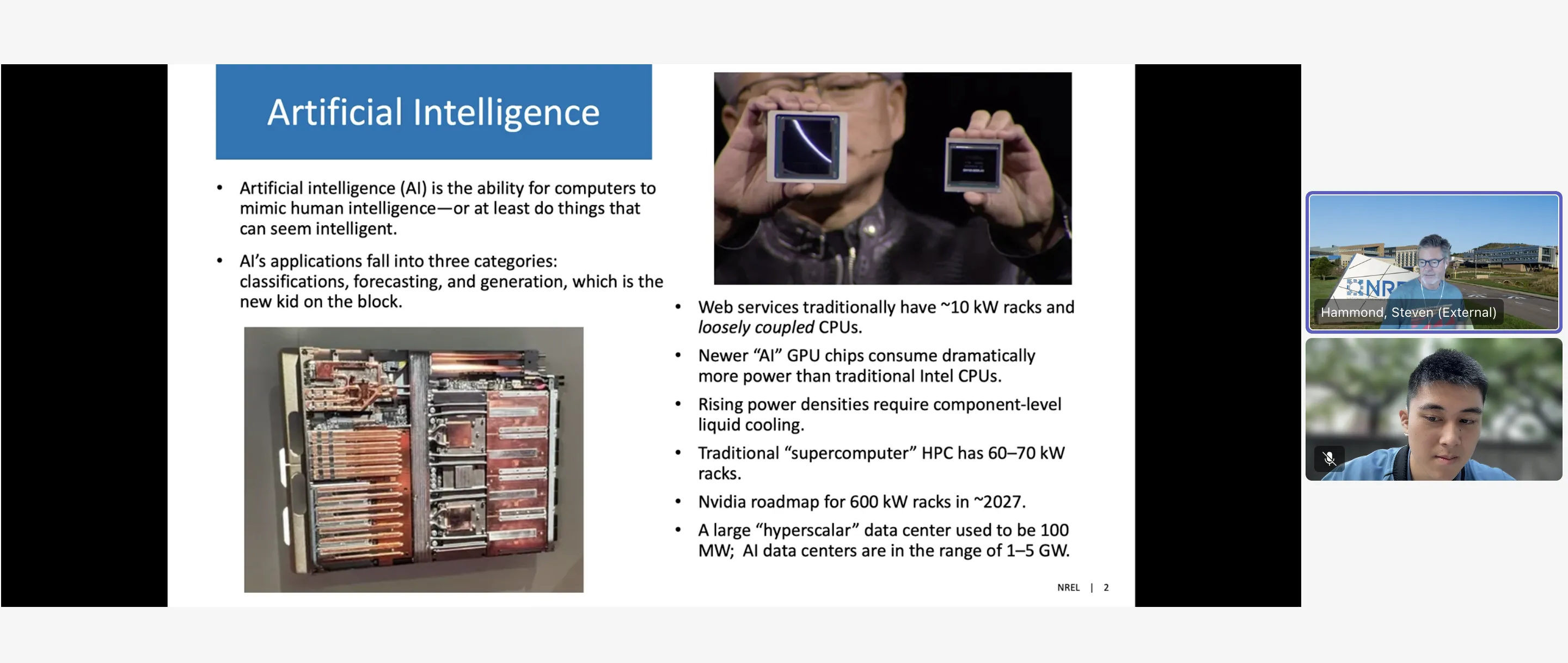
Create distributed compute network from clusters of e-waste devices that can solve computationally intensive problems. Load balancer breaks problems into parallel "mini-problems" distributed across nodes.
Technical Proof of Concept
Built working prototype demonstrating the distributed computing system. By adding just one additional e-waste node to our network, we achieved 15% faster computation on average—reducing task completion from 10.93 seconds to 9.73 seconds.
The system uses a load balancer to distribute computational problems across multiple e-waste devices running in parallel, with each node handling smaller sub-problems simultaneously. This architecture proves particularly effective for parallelizable research problems like federated learning, simulations, and data processing.
Design & Iteration
Created comprehensive Figma prototypes for the donor and researcher interfaces, iterating based on user feedback:
- Donation Interface: Interactive map showing nearby e-waste drop-off locations, device submission flow with equipment details
- Researcher Portal: Dashboard displaying recent computation runs, credit usage tracking, and terminal access for job submission
- Success Metrics: Station utilization rate >75%, dollar value of compute resources provided to non-profits, >80% user satisfaction
Key Feedback Incorporated:
- Need for specific booking times due to students' busy schedules
- Importance of communicating tangible benefits—how compute donations are used and why it matters
- Preference for upcycling over recycling when shown environmental and economic impact
Technical Challenges & Learnings
Scalability Architecture
Investigated Kubernetes vs. Docker Swarms for optimal scaling. Identified potential carrying capacity where adding nodes no longer significantly increases compute power.
Device Heterogeneity
Larger devices require VMs to ensure different architectures play nicely together. This may be challenging on very old devices with limited resources.
Problem Compatibility
System works best for problems utilizing parallelization or distributed computing (federated learning, simulations). Some problems may need rewriting or aren't compatible with distributed architecture.