Overview
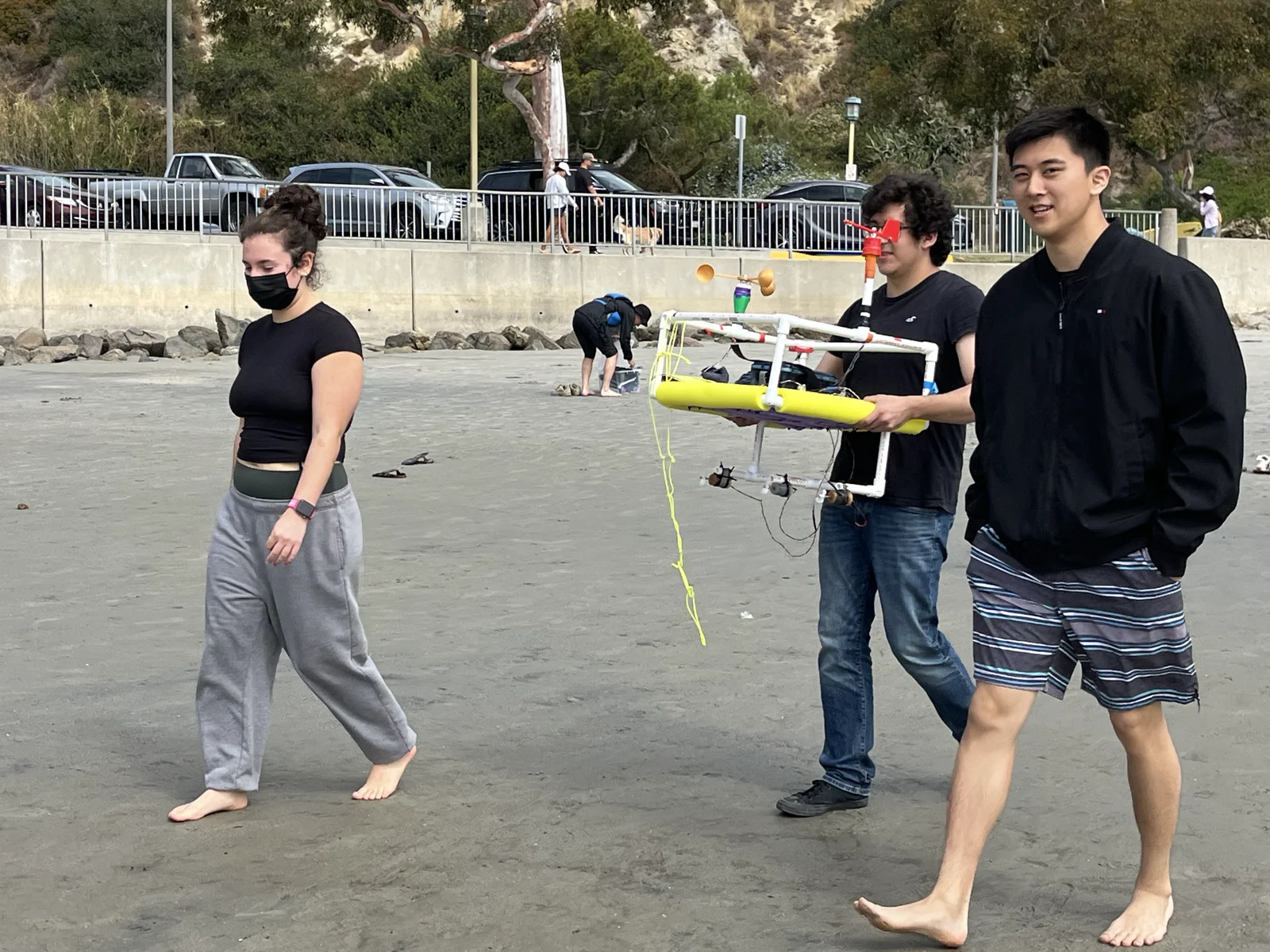
An autonomous surface vehicle that measures wind speed, wind direction, and solar irradiance at Dana Point. Those three quantities are the standard inputs for siting offshore wind and floating solar: available wind power scales with the cube of wind speed, direction sets turbine alignment, and site-level irradiance drives PV output. We built the robot to test two hypotheses, that wind rises and solar irradiance falls with distance from shore, and to hand offshore energy planners real nearshore data.
75.7xmore renewable power density from solar than wind in the cove
~475 W/m2solar irradiance measured at Dana Point
3onboard sensors, all logged on a Teensy 4.0
Photo Gallery
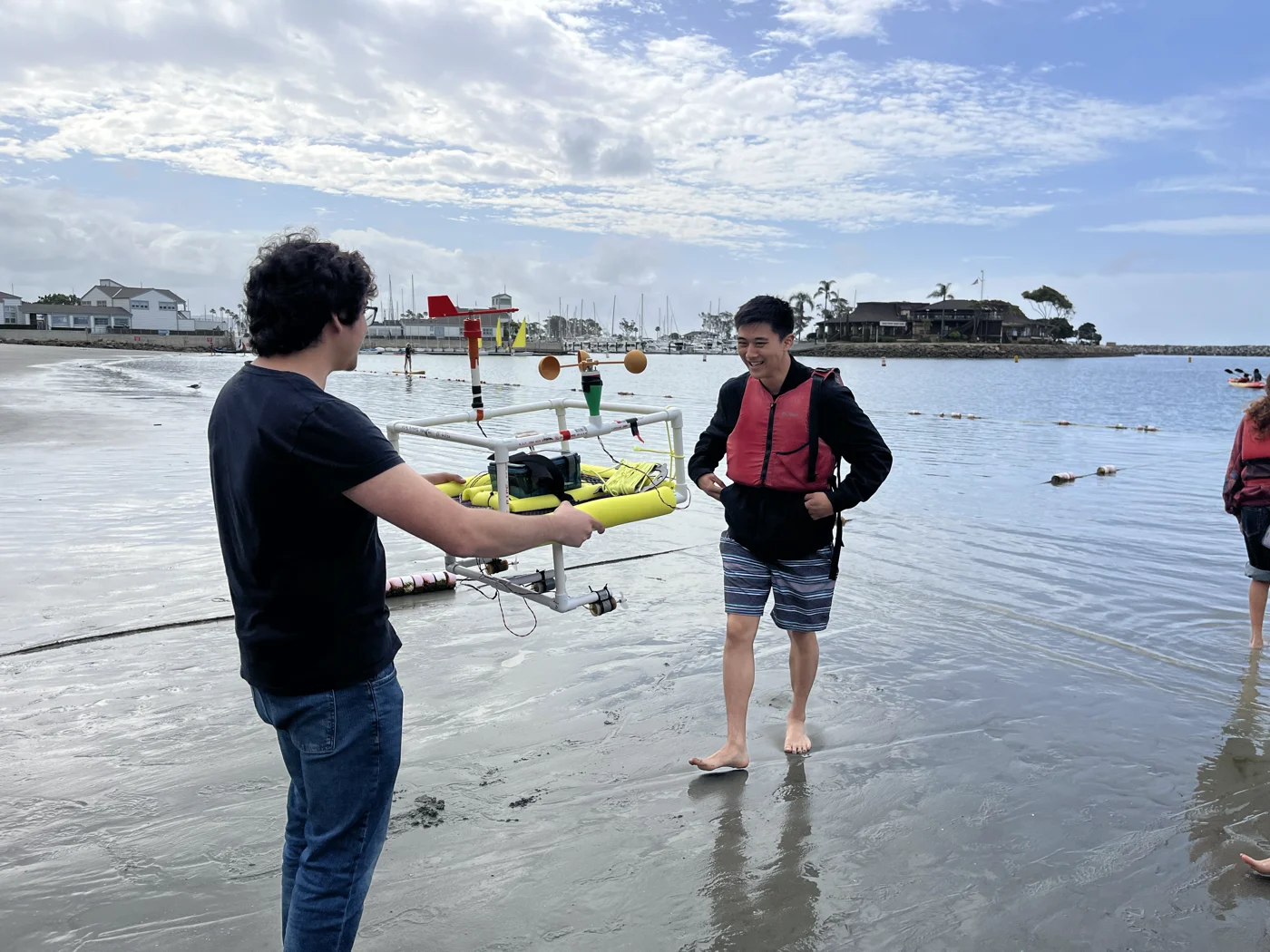
launching at the water's edge at Dana Point
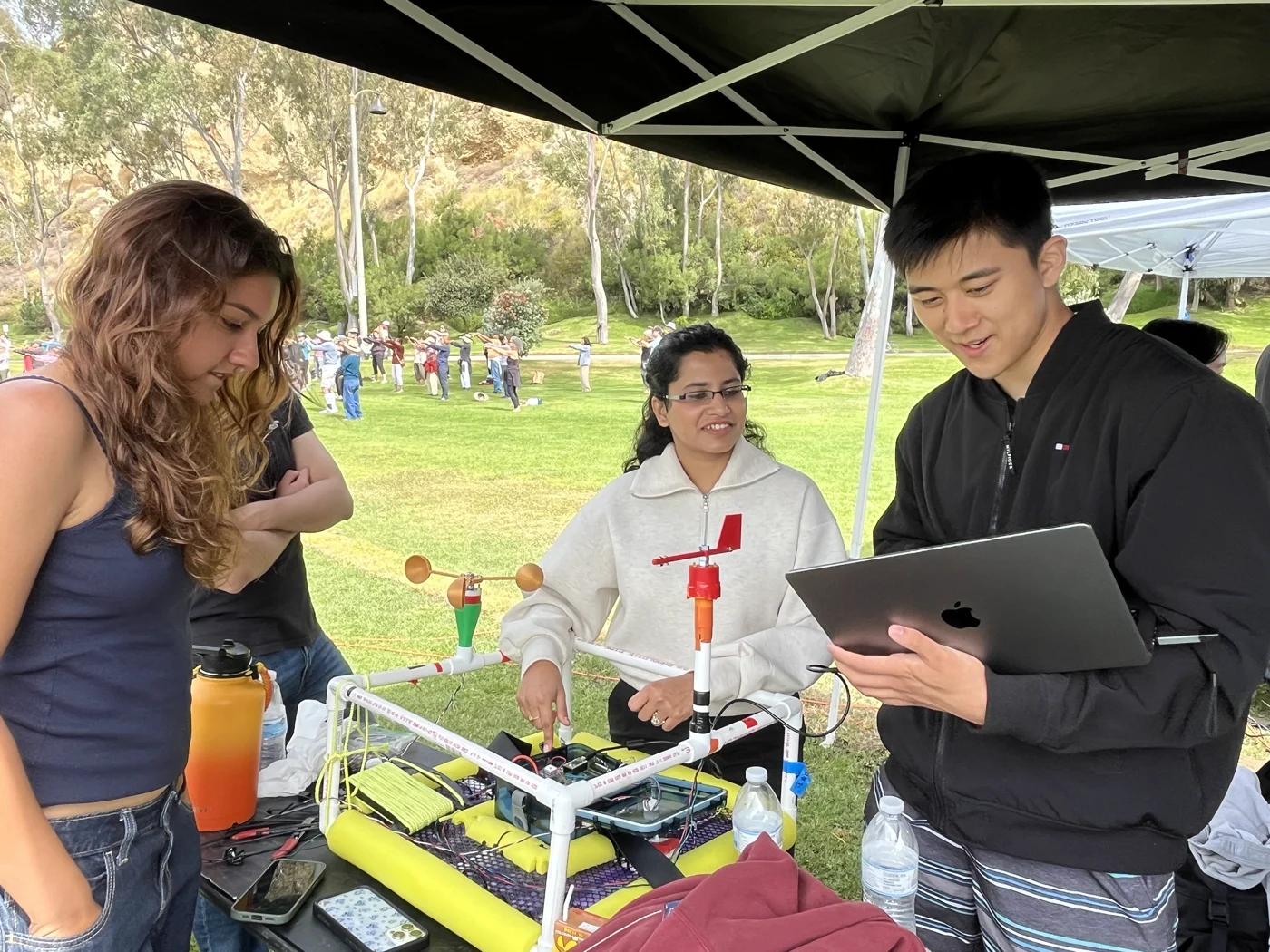
prepping the sensors before a run
What we built
A floating sensor platform on a PVC frame with pool-noodle floatation and submerged motors on an E-shaped mount, so the robot could drive itself against the waves while keeping the electronics dry and the motor noise out of the data.
- Wind speed. A custom anemometer read by a hall-effect sensor (AH9246 / A3144), calibrated in a wind tunnel by mapping pulse-count RPM to a known velocity.
- Wind direction. A weather vane on an MLX90316 angle sensor, calibrated by rotating it a full 360 degrees and mapping output voltage to heading.
- Solar irradiance. A BPW34 photodiode into a transimpedance amplifier, calibrated against a ground station and a sunset test under an acrylic cover.
- Brains. A Teensy 4.0 logging all three channels onboard.
What we found
- No significant change in wind or solar with distance from shore. That went against our hypothesis. The nearshore-to-offshore transition at Dana Cove was flatter than expected.
- Wind came primarily from the Southeast, per the weather vane.
- Solar dominated. Roughly 75.7 times more renewable power density from solar than wind in the cove (about 6.2 W/m2 from wind versus 469 W/m2 from solar), with measured irradiance near 475 W/m2 and wind between 2.57 and 4.12 m/s.
What broke and what is next
- The anemometer lost pulse count at higher wind speeds. A stronger magnet or a better hall-effect sensor fixes it.
- The robot veered off course under disturbance. Closed-loop control would remove the unbounded heading error.
- Gathering data across larger distances would give the offshore-distance hypothesis a real test.